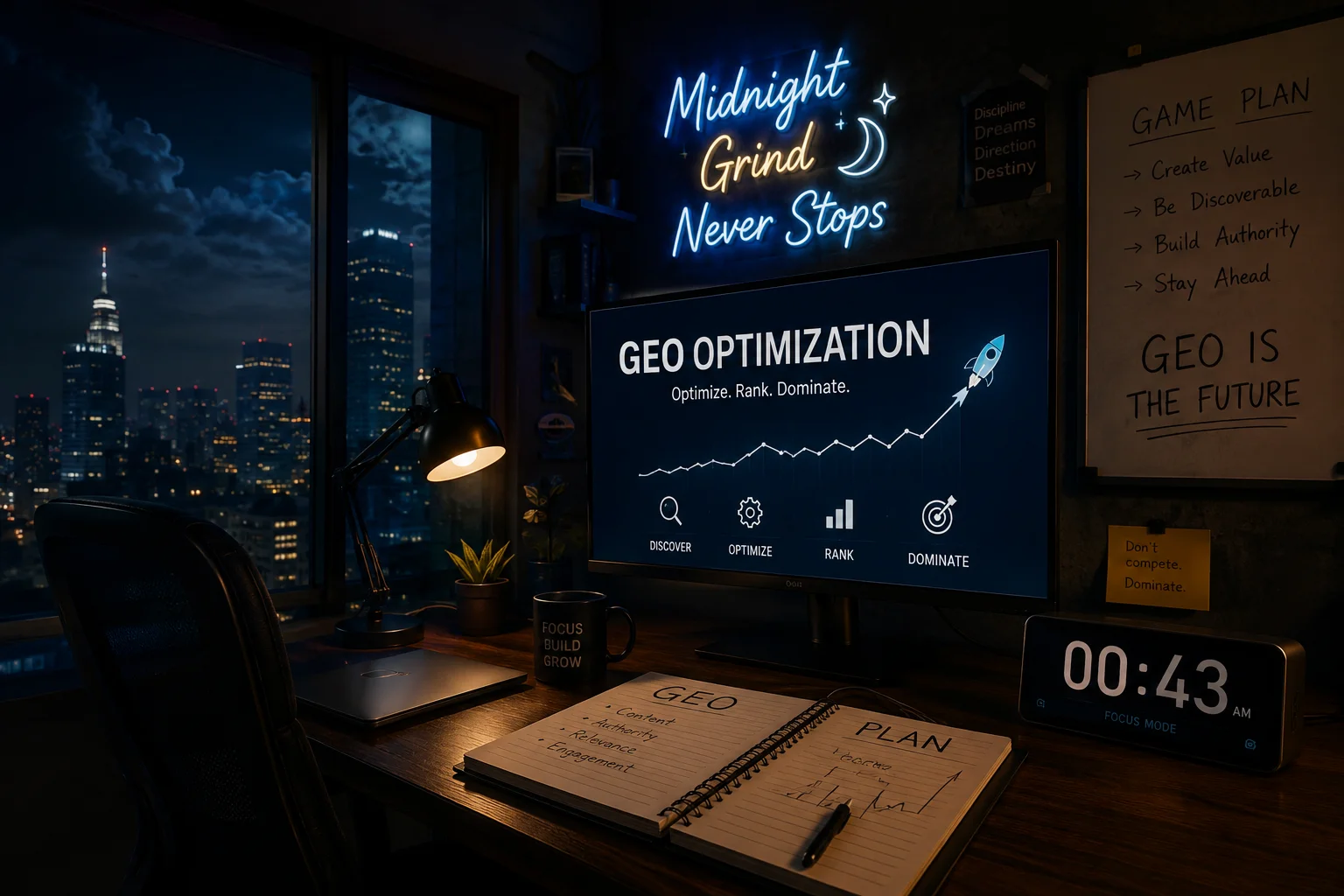
How GEO Optimization Can Help You Rank in AI Search
The New SEO Era Has Started
It’s 11 PM. The room is quiet, your laptop brightness is at 40%, and you’re still trying to figure out why your website traffic suddenly feels weird. Google clicks are unstable, AI tools are everywhere, and users are asking ChatGPT instead of typing searches into traditional search engines. Try GEO Optimization
Welcome to the new internet.
Search behavior is changing faster than most marketers expected. People now ask AI tools complete questions like:
- “Best marketing strategy for small businesses”
- “How can I improve website traffic?”
- “Top tools for content writing”
And guess what?
ChatGPT answers instantly.
That means if your content is not optimized for AI-generated answers, you’re already behind.
This is where GEO Optimization enters the game.
What is GEO Optimization?
GEO = Generative Engine Optimization
GEO Optimization is the process of optimizing your content so AI tools like ChatGPT, Gemini, Claude, and Perplexity can understand, trust, and use your content in their generated answers.
Think of it like SEO — but designed for AI systems instead of only search engines.
Traditional SEO focuses on:
- Keywords
- Backlinks
- Search rankings
- Meta tags
GEO focuses on:
- Context
- Authority
- Structured information
- Conversational relevance
- AI readability
The goal is simple:
Make AI platforms choose your content as a trusted source.
AI Search is Replacing Traditional Search
People are slowly skipping the “10 blue links” experience.
Instead of opening 5 blog posts, users now ask AI:
“What’s the best CRM for startups under $50?”
And AI gives one clean answer.
If your content is included in that answer, you win attention.
If not, you disappear.
Traffic Will Come from AI Mentions
Websites are beginning to receive:
- AI referral traffic
- Brand mentions inside AI responses
- Citations from AI-generated answers
This trend is growing rapidly.
The brands that adapt early will dominate future search visibility.
1. Write Like Humans Talk
AI tools prefer conversational content.
Old SEO content looked like this:
“Best running shoes best running shoes cheap running shoes online.”
That doesn’t work anymore.
Modern GEO content sounds natural:
“If you’re searching for affordable running shoes with comfort and durability, these options are worth considering.”
Use conversational language
Write the way people ask questions.
2. Answer Questions Clearly
ChatGPT loves direct answers.
If your article takes 700 words to answer a simple question, AI may skip it.
Good GEO structure includes:
- Short explanations
- Direct answers
- Bullet points
- Clear formatting
- Question-based headings
3. Build Topic Authority
AI tools trust websites that deeply cover a subject.
Instead of writing random blogs, create:
- Pillar content
- Topic clusters
- Supporting guides
Example:
Main Topic:
- GEO Optimization
Supporting Articles:
- AI Search Trends
- ChatGPT Ranking Factors
- AI Content Visibility
- Structured Data for AI
This creates authority signals.
4. Use Structured Headings
Headings help AI understand content hierarchy.
Use:
- H1 for title
- H2 for main sections
- H3 for subtopics
- H4–H6 where needed
Good structure improves:
- Readability
- AI parsing
- User engagement
5. Add Statistics and Real Examples
AI systems prefer factual and trustworthy information.
Include:
- Research
- Data
- Case studies
- Examples
- Expert insights
Example:
“According to industry reports, AI-powered search adoption increased significantly during 2025.”
That adds credibility.
Create Evergreen Content Try GEO Optimization
Evergreen content stays useful for years.
Examples:
- Beginner guides
- Tutorials
- Definitions
- Industry frameworks
AI tools prefer stable and informative pages.
Optimize for Semantic Search Try GEO Optimization
Don’t repeat one keyword 50 times.
Instead, cover related ideas naturally.
For “GEO Optimization,” include:
- AI search
- Generative search
- AI visibility
- conversational search
- answer engines
This helps AI understand context.
Improve EEAT Signals Try GEO Optimization
Google introduced EEAT:
- Experience
- Expertise
- Authority
- Trust
AI systems also rely on similar trust indicators.
Add:
- Author bios
- Sources
- Real experiences
- Updated information
Trust matters more than ever.
Use FAQ Sections Try GEO Optimization
FAQs are gold for GEO.
Why?
Because users ask AI direct questions.
FAQ sections increase the chances of:
- AI extraction
- Featured snippets
- Voice search visibility
1. Keyword Stuffing Try GEO Optimization
Stop writing for robots.
Write for humans first.
AI can detect unnatural content easily.
2. Thin Content Try GEO Optimization
A 300-word article with no value won’t survive AI search.
Depth matters.
3. Ignoring User Intent Try GEO Optimization
Always ask:
“What problem is the reader trying to solve?”
Solve that problem directly.
4. Publishing AI Spam Try GEO Optimization
Ironically, low-quality AI-generated content performs poorly in AI systems.
Human editing is essential.
Add:
- Personality
- Insight
- Experience
- Originality
AI Will Become the Main Discovery Layer Try GEO Optimization
In the next few years:
- AI assistants will replace many search behaviors
- Websites will compete for AI citations
- Content quality standards will rise
The internet is entering an “answer economy.”
Users don’t want links anymore.
They want:
- Immediate answers
- Accurate summaries
- Trusted recommendations
That changes content marketing forever.
Simple Action Plan Try GEO Optimization
Step 1:
Audit old blog posts.
Step 2:
Rewrite content conversationally.
Step 3:
Add FAQs.
Step 4:
Improve headings and structure.
Step 5:
Build topical authority.
Step 6:
Focus on trust and accuracy.
Small improvements today can create massive visibility tomorrow.
FAQs About GEO Optimization
What does GEO stand for?
GEO stands for Generative Engine Optimization, which means optimizing content for AI-driven search systems like ChatGPT and Gemini.
Is GEO replacing SEO?
No. GEO is not replacing SEO completely.
Instead, GEO is evolving SEO for AI-powered search experiences.
Both are important.
Can ChatGPT rank websites?
ChatGPT itself does not “rank” websites like Google, but it can mention, recommend, summarize, and reference content sources in AI-generated answers.
How do I optimize content for ChatGPT? Try GEO Optimization
You can optimize by:
- Writing conversationally
- Using clear headings
- Answering questions directly
- Adding factual information
- Building authority around topics
Does AI-generated content rank well? Try GEO Optimization
Only high-quality AI-assisted content performs well.
Low-quality automated spam usually fails.
Human editing and originality remain critical.
Read More
Category: Ai automation daily tasks free tools
ALSO READ Free AI Tools
A2Zeducen: Transforming Education for the Future
Keshav Sanghani: The Rising Star in the World of Technology
Tips To Choose The Right Tech Stack For Your Mobile App
TechnologyCrunch 88m Series: LundenTech
Unveiling the Genesis 45M Series: A Comprehensive Review of AccellundenTechcrunch
In 2021, the top technical skills to master
Prototyping vs. PoC: When to Build What in Product Development
Continuous Learning and Reskilling: AI as Teacher and Mentor
The Importance of Nebula Molloy BBC in the World of Science and Technology
TechnologyCrunch 88m Series: LundenTech
Tombolasports – A Lottery Style Game
George Davis and Augusta National: Breaking the Color Barrier
Gaining a Competitive Edge with Labs
Prototyping vs. PoC: When to Build What in Product Development
Continuous Learning and Reskilling: AI as Teacher and Mentor
Why are FAQs important for GEO?
FAQs match the way users interact with AI systems.
They improve:
- AI understanding
- Featured snippets
- Conversational relevance
Conclusion Try GEO Optimization
The internet is changing quietly at midnight while most people sleep.
SEO is no longer just about Google rankings.
Now it’s about becoming the answer AI tools trust.
That’s why GEO Optimization matters.
The brands that adapt early will gain:
- More visibility
- More authority
- More AI mentions
- More future traffic
The old search game focused on clicks.
The new game focuses on answers.
And if you want to rank in ChatGPT, GEO Optimization might be your smartest move yet.